

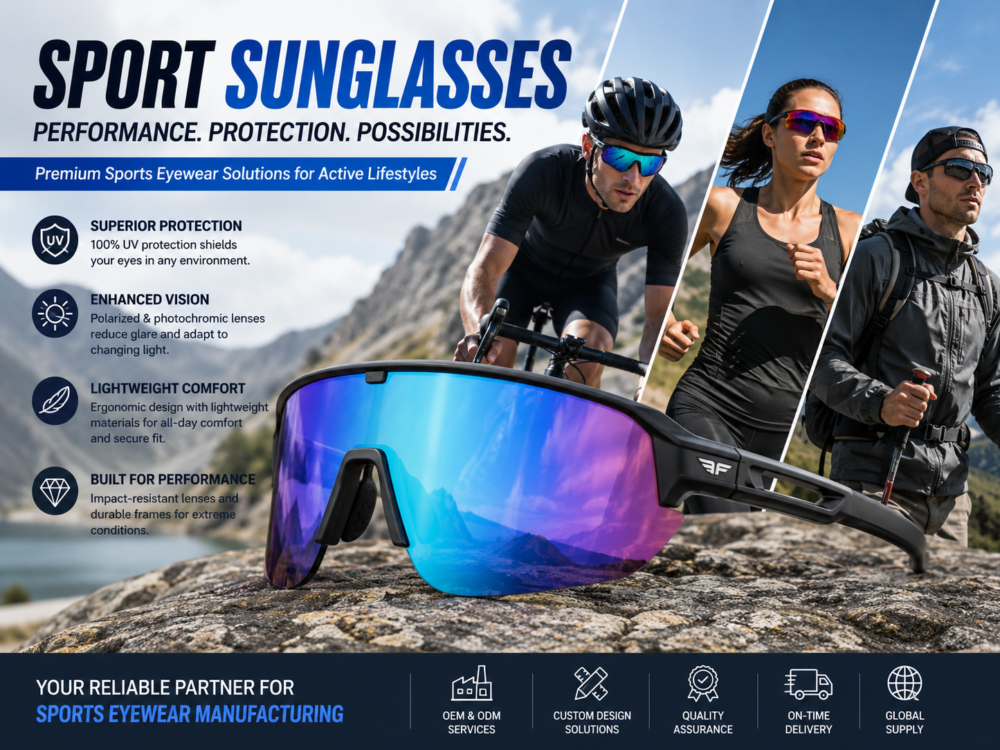
Sport sunglasses have evolved from basic protective eyewear into highly engineered products designed for performance, comfort, and active lifestyles. Today, they are widely used by cyclists, runners, hikers, golfers, and outdoor sports enthusiasts who expect more from their eyewear than simple UV protection.
For eyewear brands, retailers, distributors, and optical buyers, this evolution presents an attractive business opportunity. However, succeeding in the sports eyewear market requires more than selecting an attractive frame. Buyers need to understand product performance, lens technology, materials, consumer trends, and, most importantly, how to choose the right manufacturing partner.
Why Are Sport Sunglasses Becoming More Important?
The modern consumer expects sunglasses to provide both protection and performance. Unlike conventional fashion sunglasses, sport sunglasses are designed to remain stable during movement while protecting the eyes from sunlight, wind, dust, and other environmental conditions.
For cycling and running, lightweight construction and a secure fit are essential. For hiking and outdoor activities, UV protection, glare reduction, and lens versatility can significantly improve visual comfort. These different requirements are encouraging brands to develop more specialized sports eyewear collections.
At the same time, the boundaries between sports and lifestyle eyewear are becoming less distinct. Consumers increasingly want products that can be used during physical activities and still look fashionable when worn casually.
This creates new opportunities for a professional sport sunglasses manufacturer to develop products that combine technical performance with contemporary design.
The Key Advantages of Sport Sunglasses
One of the most important benefits of performance eyewear is eye protection. High-quality sport sunglasses can provide effective UV protection while helping shield the eyes from wind, dust, insects, and other outdoor elements.
Lens technology is another major advantage. Polarized lenses can reduce reflected glare from roads, water, and other surfaces, making them particularly useful for cycling and outdoor sports. Photochromic lenses offer another solution by adapting to changing light conditions, allowing athletes to use the same pair of sunglasses across different environments.
Frame construction also plays an important role. Wraparound designs can provide greater coverage, while lightweight materials reduce pressure and improve comfort during extended wear. Adjustable nose pads, flexible temples, and non-slip components can further improve stability during movement.
For B2B buyers, these features create opportunities for product differentiation. Instead of competing only through colors and styling, brands can build collections around specific sports, lens technologies, materials, and performance benefits.
What Are the Challenges of Sports Eyewear?
Despite its advantages, sports eyewear presents higher technical requirements than standard sunglasses.
Advanced lens technologies and specialized frame structures can increase production costs. Polarized, photochromic, impact-resistant, and anti-fog lens solutions may require additional manufacturing processes and quality control.
Highly curved shield lenses also create technical challenges. Manufacturers need to balance optical clarity, lens curvature, field of vision, structural strength, and wearer comfort. Small inconsistencies in manufacturing can have a noticeable impact on the final product.
Another challenge is that different sports have different requirements. A cycling model may prioritize aerodynamic coverage and ventilation, while running eyewear may focus more on lightweight construction and secure fitting.
Therefore, selecting a sport sunglasses supplier should not be based solely on price. Manufacturing experience, lens quality, product consistency, customization capabilities, quality control, and supply-chain reliability are equally important considerations.
Why Cycling Sunglasses Are a Growing Opportunity
Cycling is one of the most important application areas within the sports eyewear market.
Cyclists are exposed to strong sunlight, wind, dust, road debris, and rapidly changing lighting conditions. As a result, cycling sunglasses often require large lens coverage, lightweight frames, secure fitting, ventilation, and advanced lens technologies.
The market is also expanding beyond professional cyclists. Recreational riders, commuters, fitness enthusiasts, and outdoor lifestyle consumers are increasingly interested in cycling eyewear that combines performance with everyday styling.
For brands and distributors, this creates opportunities to develop different product levels—from accessible entry-level models to premium performance eyewear.
Working with an experienced cycling sunglasses vendor can help buyers develop products that are tailored to their target customers, price positioning, and sales channels.
Future Trends in Sport Sunglasses
1. Photochromic Lenses Will Become More Accessible
Photochromic technology is particularly attractive for outdoor sports because lenses can adapt to changing light conditions. As consumers look for more versatile products, photochromic sunglasses are likely to become increasingly common across different price segments.
2. Performance Meets Lifestyle
The future of sports eyewear will not be limited to professional athletes.
Consumers increasingly expect sport sunglasses to perform well during cycling, running, hiking, or other activities while also fitting into their everyday lifestyle.
This shift creates opportunities for brands to develop sport-lifestyle collections with technical features and fashionable designs.
3. Lightweight Materials Will Continue to Grow
Weight and comfort are critical factors in sports eyewear. Materials such as TR90, polycarbonate, nylon, and other lightweight engineering materials can help manufacturers create frames that are durable without adding unnecessary weight.
Future product development will likely focus on achieving the right balance between strength, flexibility, comfort, and cost.
4. Sustainability Will Influence Product Development
Sustainability is becoming increasingly relevant to eyewear brands and consumers.
Recycled materials, recyclable components, bio-based materials, and more responsible production processes are gaining attention. For brands targeting environmentally conscious consumers, material selection can become an important part of product positioning.
For a modern sporting sunglasses supplier, sustainability is therefore becoming more than a marketing message—it can become part of the product development strategy.
5. OEM and Private Label Opportunities Will Expand
Many sports brands, optical retailers, distributors, and emerging eyewear companies are looking for products that are different from standard catalog offerings.
OEM and private label development allows brands to customize frame shapes, colors, lens technologies, logos, packaging, and other product details.
This makes manufacturing flexibility increasingly important. A capable sports eyewear manufacturer should be able to support buyers from initial product concepts through sampling, production, quality control, and final delivery.
How to Choose the Right Sport Sunglasses Manufacturer
For B2B buyers, finding the right manufacturing partner is one of the most important decisions when entering or expanding in the sports eyewear category.
A reliable manufacturer should have experience with performance eyewear, understand different sports applications, and maintain consistent quality across production batches.
Buyers should also consider lens technology, material options, customization capabilities, minimum order quantities, quality control procedures, lead times, packaging solutions, and communication efficiency.
Most importantly, the supplier should be able to understand the buyer’s market rather than simply manufacture products according to a basic specification.
A strong manufacturing partnership can help brands reduce development risks, improve product consistency, and bring new collections to market more efficiently.
The Future of Sport Sunglasses
Sport sunglasses are no longer a niche product category reserved for professional athletes. They are becoming an important part of the broader eyewear market, where sports performance, optical technology, fashion, and lifestyle increasingly overlap.
For importers, retailers, optical brands, and distributors, this creates significant opportunities—but also increases the importance of product development and supplier selection.
The next generation of sports eyewear will likely focus on lighter materials, smarter lens technologies, better comfort, sustainable solutions, and designs that move seamlessly between sport and everyday life.
For businesses entering this market, partnering with an experienced sport sunglasses manufacturer can provide the technical knowledge and production capabilities needed to turn these trends into commercially successful products.
At FANSI OPTICAL, we work with eyewear brands, retailers, importers, and distributors to develop and manufacture sport sunglasses based on different design, material, lens, and customization requirements.
Looking for a reliable sporting sunglasses supplier or cycling sunglasses vendor for your next collection? Contact FANSI OPTICAL to discuss your product requirements and explore new opportunities in sports eyewear.